
Alleghany County Court Records After Jail Arrest
A jail booking record is not the same record as a criminal court case. In Alleghany County, the arrest path can start with the Sheriff's Office, Sparta Police Department, Highway Patrol, probation staff, or another agency. If the person is not cited and released, the booking side belongs to the Alleghany Law Enforcement Center / Alleghany County Jail. The court side then runs through a magistrate or judicial official, the Clerk of Superior Court, and Prosecutorial District 34. The District Attorney reviews the case and decides what charge or charges to prosecute for the State.
That difference matters when reading Alleghany County court records after an arrest. Booking charges are early allegations tied to intake, warrants, citations, or officer paperwork. Court records are the case file: charges accepted or changed by the prosecutor, court dates, case numbers, bond events, motions, judgments, and dispositions. For custody and booking status, use Alleghany County jail inmate records. For booking photos, use the records-focused Alleghany County jail mugshots page. The court record answers a different question: what case exists after the arrest, and what is its current status?
The North Carolina Judicial Branch court-records help page is the state source for court records, criminal background checks, expunctions, and obtaining copies. The screenshot below shows the official court-records help source used for Alleghany County court records after a jail arrest.
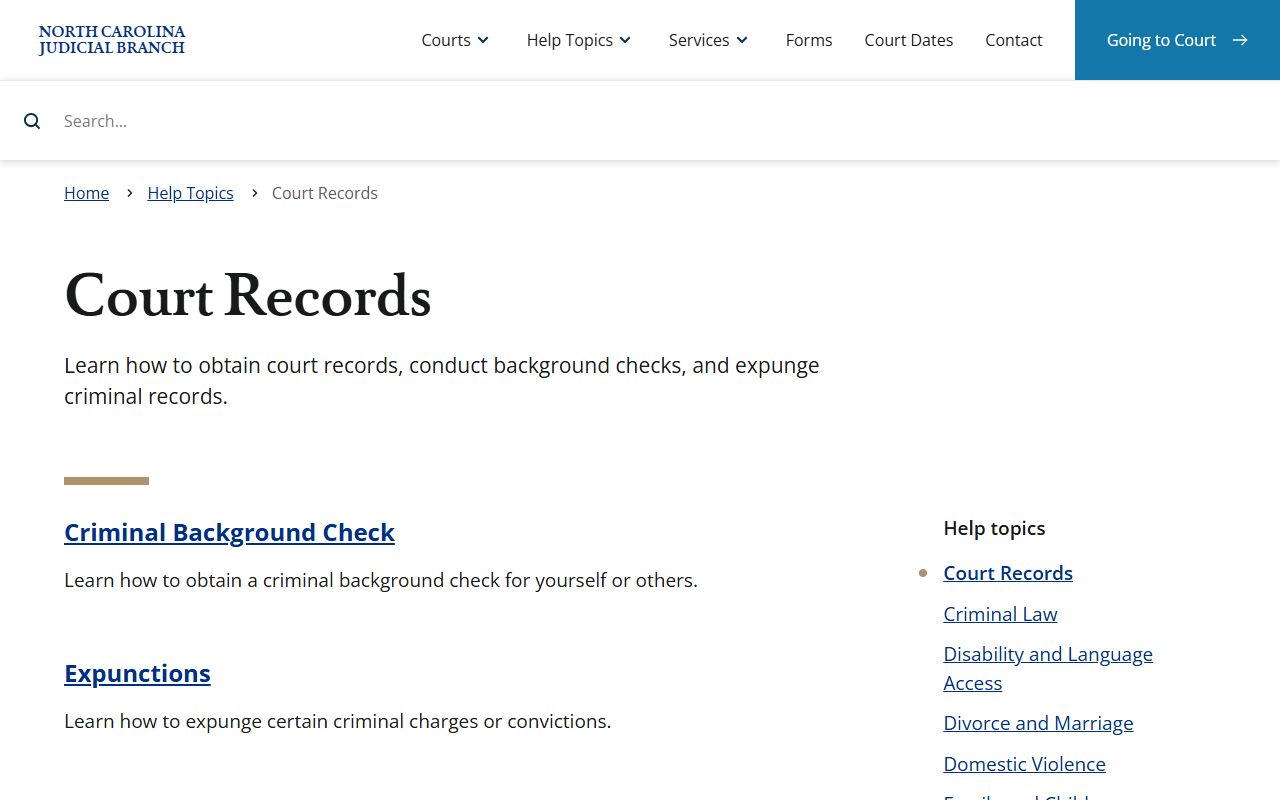
Use that state court source for file access, then use the Alleghany courthouse and Clerk contacts when the case must be checked locally.
Find Alleghany County Court Records After Arrest
After an Alleghany County arrest, the first court record may not appear at the same moment as the jail booking. A magistrate may set release conditions, a first court setting may be created, and the prosecutor may review the charge before the public case record is useful. The safest search path is to check the official North Carolina court systems, then call the Clerk when the online search does not answer the question. Court staff can help with case numbers, public access, copies, and older files, but they do not replace jail staff for current custody status.
| Channel | Use | Alleghany County Detail |
|---|---|---|
| NC Judicial Branch Portal | Search court records, court dates, and eligible payments. | Official Tyler-hosted court portal linked by the Judicial Branch. |
| Court-date search | Check scheduled settings after a court date exists. | Linked from the Alleghany courthouse page. |
| Clerk of Superior Court | Ask about case numbers, copies, older records, and access limits. | 336-372-3900. |
| Alleghany County Courthouse | In-person court access and local court services. | 12 N Main St, Sparta, NC 28675, Monday-Friday, 8 AM-5 PM. |
| District Attorney | Prosecutor contact and victim-related case context. | Local contact listed at 336-372-3910. |
Search fields vary by portal screen, but the research captured the court channel at a practical level. Name search, case number, citation or payment flow, and court-date search are the supported paths. If the court portal shows a case but jail staff cannot confirm custody, the person may have bonded out, been cited and released, been transferred, or have a court file without current jail custody.
| Search Field or Tool | Type | Required | Notes |
|---|---|---|---|
| Search court records | Web portal | Unspecified | Official Tyler-hosted portal may expose case, party, citation, or payment search flows. |
| Find my court date | Web search | Unspecified | Linked from the Alleghany courthouse page for court-date lookup. |
| Make a payment | Portal flow | Conditional | Eligibility depends on citation, case type, and court status. |
| Clerk fallback | Phone or in person | Case details helpful | Use when the portal does not show enough public detail or copies are needed. |
Alleghany Arrest to Court Record Path
The local sequence is best read as a chain: arrest or citation, booking if jailed, magistrate or pretrial release review, first court date, prosecutor review, court file, and disposition. The Alleghany magistrates are listed at 336-372-4911, and North Carolina pretrial release rules control whether a person is released on promise, custody release, unsecured bond, secured bond, or held under a special rule. The court date becomes useful once it exists in the court system, but it may not prove that the person is still in jail.
- Confirm whether the person was booked locally through the Sheriff's Office or jail phone line.
- Check whether a court date exists through the official Alleghany court-date search.
- Search the court portal by defendant name, case number, citation, or payment path when available.
- Call the Clerk of Superior Court if the case is not clear online or copies are needed.
- Review each charge separately because one arrest can produce more than one case or status.
The Alleghany courthouse page documents the courthouse access point for local court services and court-date links.
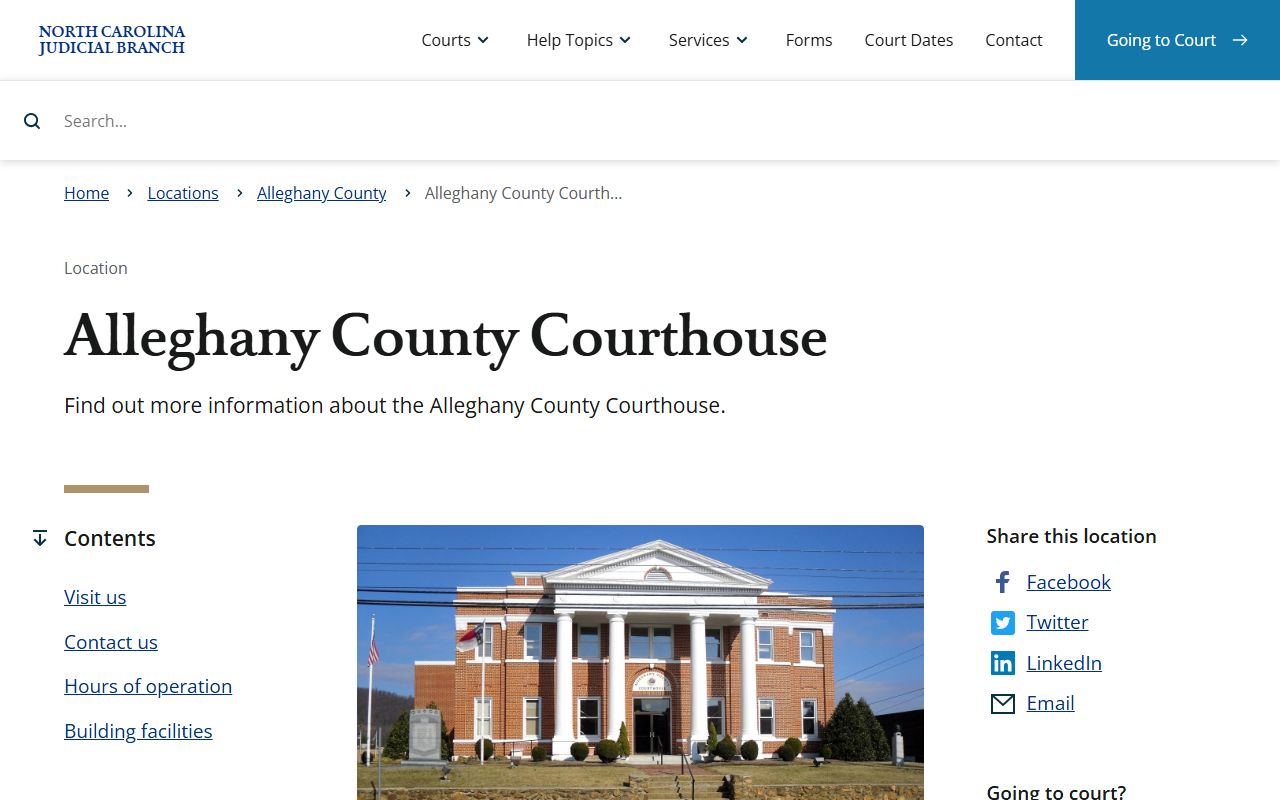
The courthouse channel is the local fallback when the online case search does not show enough detail about a post-arrest case.
Alleghany County Charging Documents
Charges do not stay frozen at booking. The arresting officer or warrant may describe one allegation at intake, while the prosecutor may file, amend, reduce, dismiss, or seek an indictment on a different charge. The research identifies complaints, informations, indictments, warrants, citations, and returned warrants as terms readers may see when court records after a jail arrest are reviewed. Returned arrest warrants, search warrants, and indictments are public court records unless sealed by court order under North Carolina law.
| Document | Who Uses It | What It Means After Arrest |
|---|---|---|
| Complaint, warrant, or citation | Officer, judicial official, or prosecutor depending on case type. | May start the case or document the allegation that led to arrest or court appearance. |
| Information | Prosecutor. | A prosecutor-filed accusation used in certain criminal contexts. |
| Indictment | Grand jury. | A formal felony charging document that may supersede or refine earlier allegations. |
Alleghany County is part of Prosecutorial District 34, which serves Alleghany, Ashe, Wilkes, and Yadkin counties. The district page identifies Tom Horner as District Attorney. His office represents the State, while the Clerk maintains court records and the Sheriff's Office maintains local jail and booking records.
Alleghany County Charge Status
Each charge in an Alleghany County court record should be read by status, not just by the name of the offense. A pending charge is an unresolved accusation. A dismissed charge is no longer being pursued in that case. A guilty finding, plea, deferral, probation judgment, or active sentence changes the record from accusation toward disposition. One arrest can also create both court status and jail status, and those are not the same thing.
| Status | Meaning | Why It Matters |
|---|---|---|
| Pending | The charge is still open. | Future court dates, bond terms, or prosecutor action may still apply. |
| Amended or reduced | The court charge changed from an earlier allegation. | The booking charge may no longer match the prosecuted charge. |
| Dismissed | The charge was not pursued to conviction in that case. | The arrest or booking entry may still exist unless expunged. |
| Guilty, plea, or judgment | The case reached a conviction or judgment event. | Sentence, costs, probation, or custody transfer may follow. |
| Not guilty | The charge did not result in conviction after adjudication. | Record access and expunction questions may still need court review. |
Note: Read every charge line separately because one arrest can include different statuses for different counts.
Bond After Alleghany County Arrest
North Carolina pretrial release is set by a judicial official under G.S. 15A-534. Release conditions can include a written promise to appear, custody release, unsecured bond, secured bond, or other statutory conditions. The local jail page does not publish a bond desk, payment window, or accepted payment methods, so call 336-372-4455 before trying to post bond for an Alleghany County jail arrest. Court payments for fines, costs, or eligible citations are separate from jail bond.
| Release Type | How It Works | Local Research Note |
|---|---|---|
| Written promise | Release based on a promise to appear. | Set by the judicial official when allowed. |
| Unsecured bond | No money is paid up front, but payment is owed if the person fails to appear. | Ask the jail or magistrate for exact terms. |
| Secured or surety bond | Money, property, or a bail agent may be required before release. | Verify where payment or paperwork is accepted. |
| No-bond or hold | Release is blocked until another court action or agency clearance. | May involve warrants, probation, domestic-violence rules, federal holds, ICE, or court orders. |
Alleghany County Warrants and Court Records
No official Alleghany County active-warrant search, warrant list, or most-wanted roster was located on the county website. The Sheriff's Office page does confirm that the office serves warrants, writs, subpoenas, summonses, and civil process, and extradites prisoners. A warrant can lead to booking at the county jail and then court records after the arrest, but an online warrant database should not be assumed.
Use the Sheriff's Office at 336-372-4455 for warrant-service process questions, the magistrates at 336-372-4911 for initial appearance or release issues, and the Clerk at 336-372-3900 for public case records. Do not rely on unofficial warrant websites. If surrendering on a warrant, ask where to report, whether bond has been set, and whether paying old costs or fines is enough to clear an order for arrest.
Charges, Convictions, Sealed Records
Alleghany County court records after a jail arrest can show allegations that are not convictions. A charge is the accusation being processed by the court. A conviction requires a guilty plea, guilty verdict, or other judgment that counts as a conviction under law. North Carolina expunction law is a separate court process for qualifying matters and should not be confused with a case that is merely dismissed or less visible online.
| Item | Charge | Conviction |
|---|---|---|
| Stage | Accusation after arrest, citation, warrant, or prosecutor filing. | Final judgment, plea, or verdict event. |
| Proof level | Not proof of guilt. | Reflects a legal outcome. |
| Record issue | May remain as public case or arrest history unless restricted. | May affect sentence, probation, costs, or later records checks. |
North Carolina G.S. 15A-145.5 covers expunction eligibility for certain nonviolent misdemeanors and felonies, while G.S. 15A-153 describes the purpose and effect of an expunction.
| Record Type | Plain Meaning | Alleghany County Search Effect |
|---|---|---|
| Sealed | Hidden from ordinary public access by court order or law. | Online searches may omit it, and the Clerk may cite access limits. |
| Expunged | Cleared from qualifying public record entries after a court order. | Public search results should not be treated like a normal open case file. |
| Investigative record | Law-enforcement record that may be withheld under G.S. 132-1.4. | Basic arrest information may still be public, but full investigative files are different. |
Restricted Alleghany Court Records After Arrest
North Carolina public-records law gives broad access to public records through G.S. 132-1 and inspection or copy access through G.S. 132-6. Criminal records have limits. G.S. 132-1.4 treats criminal investigative records differently while preserving access to specified arrest information, including the name, age, address, alleged violation, and circumstances of arrest unless another law blocks release.
Important: This resource is not a consumer reporting agency and may not be used for employment, tenant, credit, insurance, or other FCRA-covered screening.
Juvenile matters, sealed files, expunged cases, active investigative records, protected victim or witness information, and court orders can limit what appears in public court records after an arrest. If online search results do not match jail information, call the Clerk or the records custodian rather than assuming the case does not exist.